Division V focuses on the development and application of advanced information technologies, including intelligent control, big data analysis and fusion, multi-sensors monitoring, complex system modeling, artificial intelligence, digital twin technology, and deep learning. The team is dedicated to solving critical challenges in areas such as material damage mechanism identification, data-driven and hybrid modeling, non-destructive testing and detection, system reliability assessment, and remaining lifetime prediction. 延伸阅读
Research Areas
1. Data governance and advanced deep mining techniques 同题参见
2. Multimodal fusion and monitoring detection technologies 延伸阅读
3. Multi-scale and cross-scale digital twin technology
4. Reliability analysis and remaining service life prediction
Research Highlights
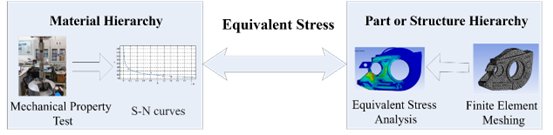
1. Cross-scale Service Evaluation Method for Structural Materials
The cross-scale service evaluation method of structural materials converts the structure simulation results at the macroscopic scale with the test data at the micro-mesoscopic scale, and comprehensively considers the mechanical properties and failure mechanisms at different scales to more accurately evaluate the performance and remaining life prediction of the structural materials in the actual service process.
2. Intelligent Management and Control of Process Qualify
Process quality is a core indicator in industrial production. However, in industrial production, quality control is often challenging, with a complex process, numerous parameters, and strong timeliness. Take steel continuous casting production as an example. we conduct data governance of the continuous casting process, develop a hybrid model based on mechanism and data - driven approaches, optimize process parameters using data statistics and artificial intelligence algorithms, carry out quality analysis with the help of large - language models, fully explore data value, and achieve intelligent control of continuous casting.

3.Artificial Intelligence Technology in Medical-Industrial Integration Applications
Using mechanical simulation and data-driven methods to study the mechanical behavior of implanted prosthesis during postoperative rehabilitation, and to carry out patient-individual postoperative service evaluation of artificial implanted prosthesis and intelligent recommendation of postoperative rehabilitation programs.

4. Multi-dimensional and Multi-modal Data Fusion Analysis of Targets
Based on general object detection, we conducted research on multi-dimensional and multi-modal object detection to address the challenges of detecting objects with large dimensional variations, high density, and difficulties. We conducted research on multi-dimensional object detection to address the challenges of detecting dense and weak objects, and made designs and innovations at the data level, feature level, and model level.


phones:+86-10-62333510
Email:ncms@ustb.edu.cn
Address: 12 Kunlun Road,Changping District, Beijing, 100026
本页围绕「米兰app官网登录入口手机版登录」梳理公开信息,便于对照栏目动态与后续阅读。
移动端与电脑端入口保持一致。如某条暂不可用,可改走栏目列表继续查找。
列表适合快速定位,正文适合核对表述。两者都保留在站内即可形成完整阅读路径。
About Us| / Division I / Study Abroad / Division VI / Division III / Facilities|
